by Abby Kruppa
My analysis of three theories: Maslow’s Hierarchy of Needs, Bloom’s Taxonomy, and Backward Design. What information can they offer us, and why does it matter? Technology for Leading and Learning, Module 2

Maslow’s Hierarchy of Needs

Maslow’s Hierarchy of Needs, a 20th century psychological theory on the needs of humans and how it effects their behavior, is a proposal that I personally find predictable. Nothing about Maslow’s pyramidal approach to human needs is surprising, in my opinion, and when it was criticized as being too rigid (as pyramids are), he seemed to adjust and water down his theory into what I consider basic human logic. Harsh as this may sound, I am often skeptical of such psychological theories which impose grandiose life designs.
“Maslow (1943) initially stated that individuals must satisfy lower level deficit needs before progressing on to meet higher level growth needs. However, he later clarified that satisfaction of a needs is not an “all-or-none” phenomenon, admitting that his earlier statements may have given “the false impression that a need must be satisfied 100 percent before the next need emerges” (1987, p. 69).”
https://www.simplypsychology.org/maslow.html
Above is a quote from an article on Maslow’s Hierarchy of Needs by simplypsychology.org. I find it compelling because it supports my claim regarding Maslow diluting his original theory.
To be fair, most of Maslow’s theory is filled with simple, logical facts. The first four stages of the pyramid- physiological needs, security needs, belongingness/love needs, and esteem needs- are basic principles which I can agree with. However, the concept of self-actualization being the ultimate point in one’s life journey seems vapid to me personally. It is described as “realizing personal potential, self-fulfillment, seeking personal growth and peak experiences.” Funny enough, Maslow refined his theory to include a final stage in the pyramid called Transcendence, which goes beyond the personal self. All in all, I do not find Maslow’s Hierarchy of Needs to be enlightening or uplifting, personally or socially. Cynical as it may sound, I think everything he proposes psychologically is something we as people can figure out easily.
Bloom’s Taxonomy
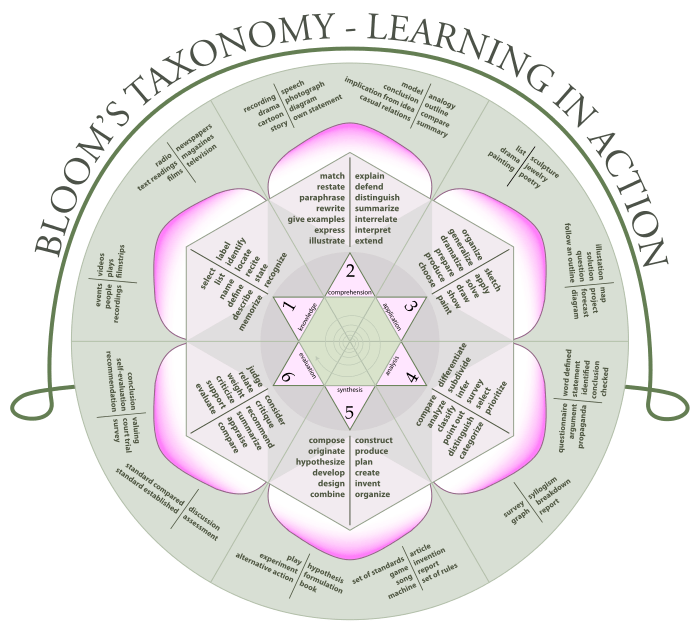
For all my optimistic readers, never fear! Despite my distaste for Maslow’s Hierarchy of Needs, I feel that Bloom’s Taxonomy is an excellent tool for productivity and compartmentalizing different areas of work. Three domains are detailed- cognitive, affective, and psychomotor- and are further divided. There is both the original domain, when Dr Benjamin Bloom created the tool, as well as a set of educational domains that are more reflective of today’s learning. Back when he created the domains, technology was not considered as heavily as it must be today.
Probably my favorite aspect of Bloom’s Taxonomy is the relationship between the domains and their key words. Maybe it’s just how my mind works, but associating a list of action verbs with each domain solidifies each concept and integrates his theory in the way I learn effectively.
In Andrew Churches’ applicative article of Bloom’s Taxonomy with Technology, he provides examples and explanations of digital actions which correspond to each domain. For instance, a verb example of the domain “remembering” is “googling”, and an example of “understanding” is “subscribing”. I find this process of digitalizing Bloom’s Taxonomy fascinating and directly applicable.
Backward Design

The last theory I will analyze in this blog posting was proposed by Grant Wiggins and Jay McTighe. Similar to Bloom’s Taxonomy, its purpose is to understand the educational process and master it. Yet instead of focusing on the learning aspect, backward design is intended for teachers. There are three clear stages which outline how to best create curriculum. Overall, I think that Backward Design is an excellent concept and tool which should be implemented by teachers. It is too easy to teach filler content in a classroom setting, which ends up being a huge waste of breath for the teachers, brain power for the students, and time for both parties. As important as busywork may be for students to lock key concepts into their brain, it is far more important to teach what you want students to end up learning. The philosophy that throwing thousands of facts at students to see which facts they internalize is ineffective and unrealistic. If teachers were instead specifically honing in on just a few big ideas with an end goal in mind, I think they would see the kind of results they dream about. Though it will take more focus and preparation to design curriculum that challenges students in a non-traditional manner, I believe it would be for the best.

Articles I Studied & Quoted:
 Abby Kruppa